The New Kid In Town
"Thirty-five years sober. The voices are quieter now. But some nights, the blues come knocking — and for a little while, I'm that new kid in town all over again."
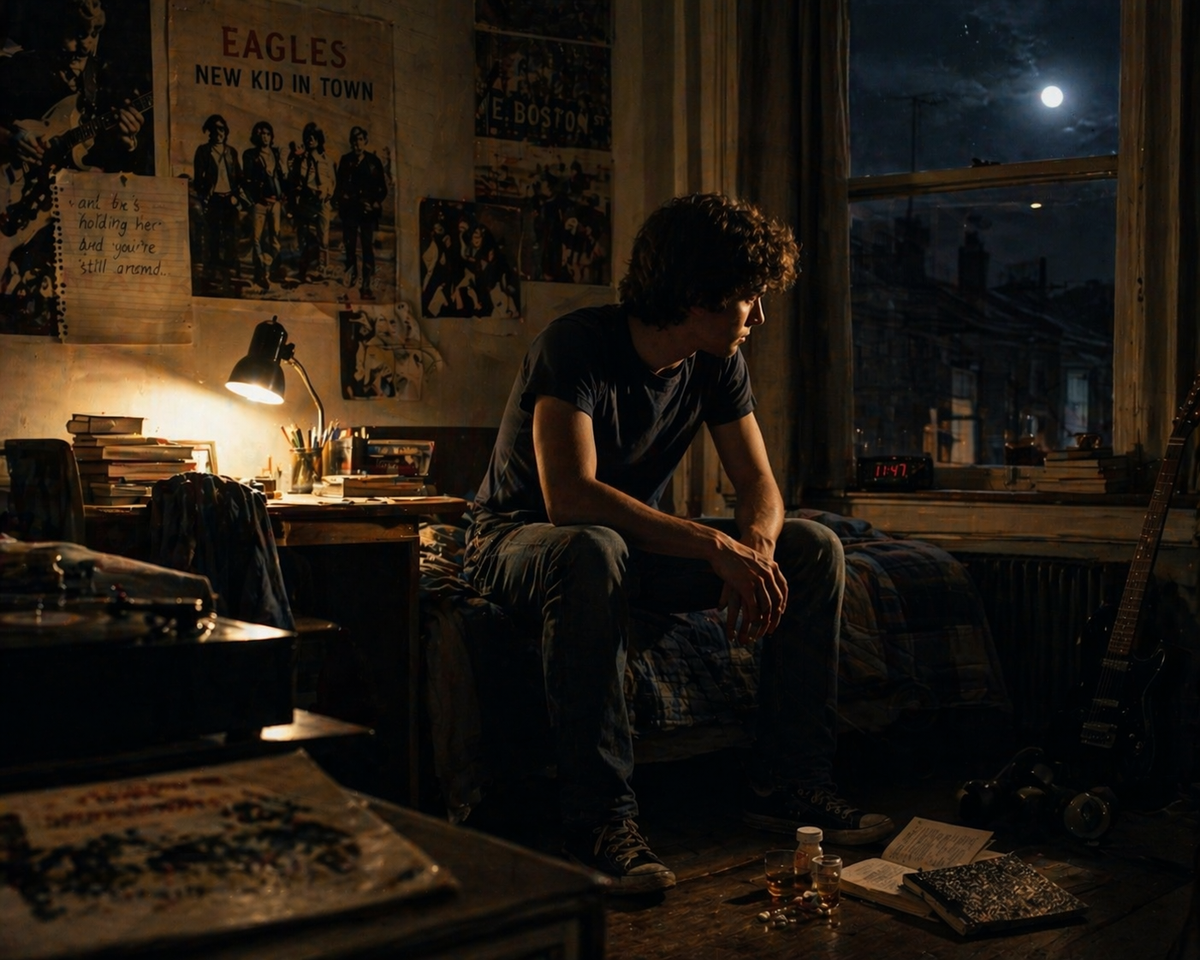
Ending up alone was inevitable. I knew it the first time I heard “New Kid in Town” by the Eagles—especially that last line: “and he’s holding her and you’re still around.” It’s not their best song—too much soft country-pop, not enough teeth—but those lyrics cut deep for anyone who’s ever watched something slip away. Every time I heard it, my heart skipped a beat and the hair on my neck stood up.
Hundreds of songs made me feel something, but this one was different. Most made me feel good; this one carved me hollow. It was the first song that left me with that punch-in-the-gut emptiness you get when you realize things end—like when you first understand your parents won’t always be there, or that childhood is already slipping away .
At sixteen, most kids couldn’t find their ass with both hands. But me? I was the guy who could. I was going steady with a girl two years older, played in a band, and ranked in the top five percent at a prominent private school. Meanwhile, most of my peers were short and pimply-faced, their voices still cracking. I’d watch them in the hallway—shuffling, awkward—waiting and wondering which one would eventually become the “New Kid in Town” to my “Johnny Come Lately.”
Those should’ve been glorious times. Instead, every morning I woke up dreading the day my friends and family would discover the ugly truth—the one I faced alone in the dark: that I was a fraud. A minor leaguer somehow playing in the majors.
Here’s the hard truth: no matter what gifts you're given or chances you take, some part of you knows you’ll come up short in the end. This wasn’t some passing teenage angst—it was written into my DNA, a certainty I couldn’t shake no matter how hard I tried. And that was the hell of it: knowing it so damn young.
There were meetings, discussions, sessions—parents, teachers, and counselors all trying to make sense of why anyone would torch their own future. It was easy to blame drugs, but no one bothered asking why I needed them in the first place. I knew, but I couldn’t say it out loud.
I'd spend endless nights in my room, textbooks stacked high, unable to breathe. Not from the work—hell, I could do that in my sleep—but from the crushing sense that none of it mattered. That nothing I did would ever feel like enough. That night, I tried Valium. For the first time, the pressure in my chest eased up. For a moment, I could breathe.
My life became this endless loop: almost making it, then crashing and burning, then clawing my way back from the ashes. The thrill wasn’t in winning—it was in trying to piece everything back together again. How do you say that without sounding insane? They’d never understand. But the drugs did—in their own twisted way.
Some days, a chemical salve—equal parts pot and booze—would cool the boil of self-doubt in my gut just long enough to get through another day. But it never silenced the relentless chatter in my head.
I tried everything—uppers, downers, anything to stop the choir of critics reminding me I’d peaked at sixteen and it was all downhill from there. Angel Dust, Valium—they dulled the voices for a while, but those whispers always turned to screams again. I kept mixing and matching, searching for the one that would finally quiet it all.
One day, I found it. I’d taken it almost an hour before, and at first—nothing. Then something sparked on a cellular level. Warmth flickered down my spine and into my belly—like cocoa and a blanket on a snowy night, but richer, deeper. The perfect blend of first kisses, family hugs, and puppies, all wrapped in a small white pill. Sweet mystery of life—found.
Now I know what real quiet sounds like. It’s the steam rising from my first cup of coffee at dawn, when the world hasn’t started making demands. It’s the weight of a good book in my hands—pages that don’t judge, stories that don’t ask me to be anything other than present. Sometimes it’s just watching rain streak down windows, or the way afternoon light cuts through dust motes like they’re dancing just for me.
I’ve learned to find something close to that old warmth in simpler things: the satisfaction of conversations with old friends, the ritual of facing my truth each morning, the insignificant victory of choosing water over something stronger. Everyday things are a kind of meditation now—the ordinary miracle of having choices, of being trusted with my life again.
The voices still carry, but they’re quieter now. And when they get loud, I’ve got other things to listen to: birds outside my window, the hum of the refrigerator, my breathing. Turns out the world’s been offering its own kind of high all along—I just had to get clean enough to feel it.
I’ve known love—genuine love—and I’ve let it slip through my fingers more than once. Not because I didn’t want it, but because some part of me always believed I didn’t deserve to keep it.
In the end, my prediction was right: I am alone. But it’s a solitude I’ve chosen, not one born of loss or loneliness. In the quiet, I find peace. Most days, I’m just grateful to be here.
Still, on some frosty, full-moon-lit nights, the blues come knocking—and for a little while, I’m that new kid in town all over again.